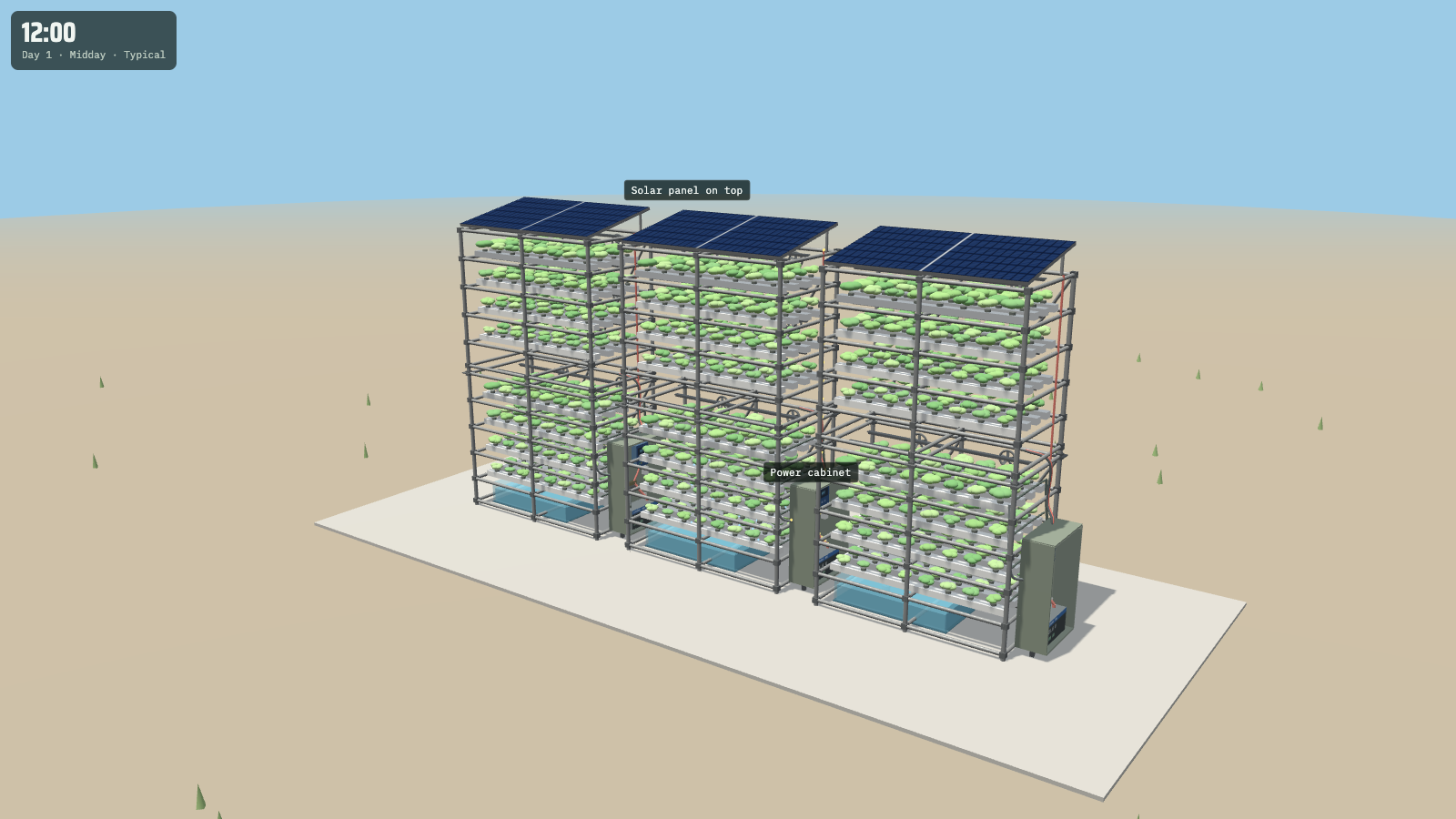
Our goal is a hydroponic farm that looks after itself: it makes its own power, watches its water, decides what each crop needs, and seeds and harvests with a robot. We are building it one version at a time. Beside this text, v3 runs a simulated day.
v2 growing nowv3 solar, sensors, dashboard: this raisev4 · v5 AI and robotics, the goal
01 Power
The sun goes on top
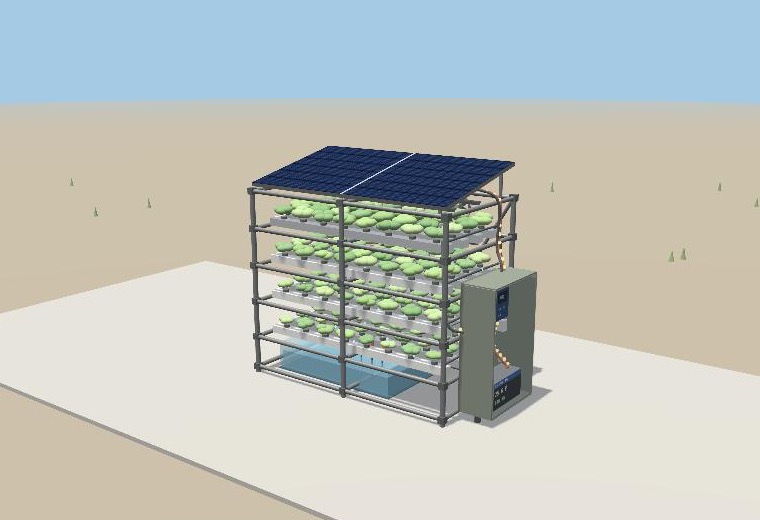
Every module carries its own ~450 W solar panel as a roof. The power source uses no extra ground, and its shade keeps the top tier cooler.
~1,350 Wh / day*Tilt ~12°450 W
02 Storage
All the power in one small cabinet
A lockable cabinet on the end of the frame holds the 24 V lithium battery, the charge controller and the controller board. The yellow dots show energy flowing from the panel into the battery and out to the farm.
24 V DC2.56 kWhNo inverter
03 Water
Water that never stops moving
The pump lifts nutrient water to every tier. It flows past the roots in the channels and drains back to the tank. There is no soil, and the same water goes round again.
Closed loopPump 24 h~20 W
04 Night
Growing after dark
After sunset the battery takes over. LED grow lights extend the day and the pump keeps running. Drag the clock to see any hour.
05 Cloudy days
When the clouds stay, the plants still drink
If the battery runs low, the controller switches loads off in order. Fans go first, then the lights. The pump always keeps running.
Fans off< 35%
LED lights off< 20%
Pumpalways on
06 Scale
As big and as high as you want
Modules are built like scaffolding. Bolt them side by side or stack them upward. Each one brings its own panel, battery and controller, so the farm stays solar however large it gets.
Sizes in the model are for illustration.
07 Roadmap
See every version, from v2 to v5
Switch versions and the farm beside this text changes. v2 and v3 are real designs. v4 and v5 are future concepts that this raise does not fund.
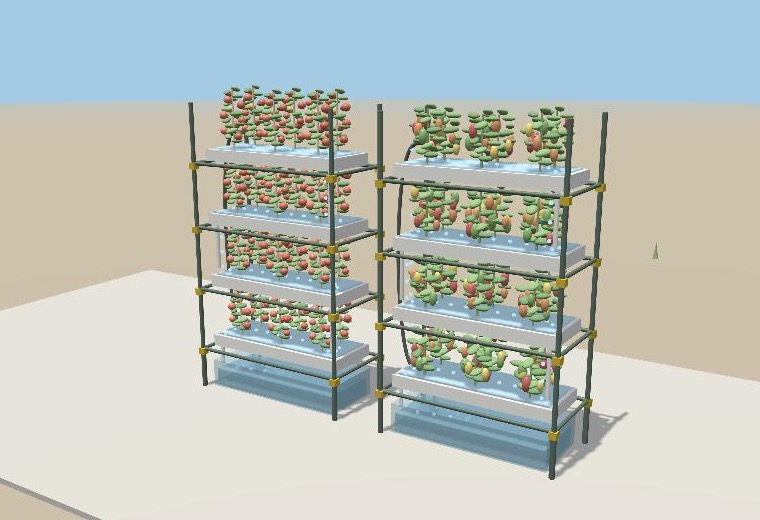
v2 · Stacked, no solar
Our own stackable design. Each layer works on its own, so a stall can grow to four layers or come down to one. A pump in the bottom tank lifts nutrient water to the top layer, and it runs down through every layer and back to the tank. Here: one stall of tomatoes, one of peppers, fully grown.
v3 · Solar, sensors, dashboard
The version this raise builds. The panel on top powers everything through a 24 V battery cabinet. Sensors watch the water and a live dashboard opens on any phone.
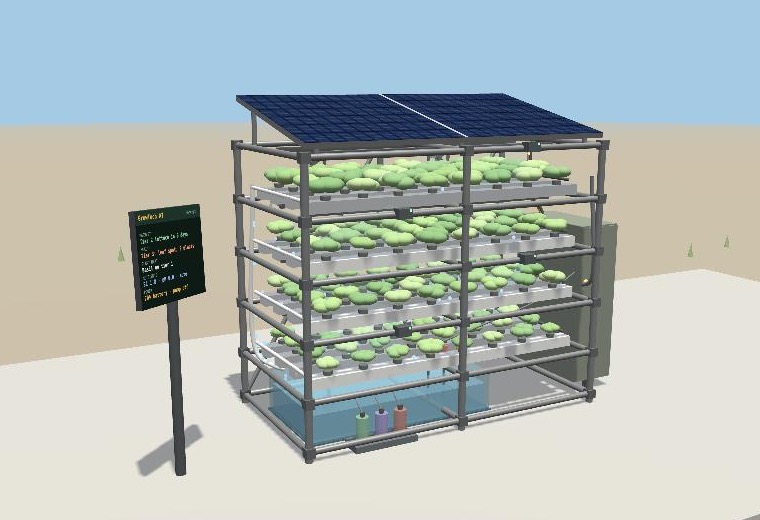
v4 · AI Future concept
Cameras on every tier and an AI that predicts harvest dates, spots disease early and says what to plant next. A screen on the farm shows it all, and pump, lights and nutrients run by themselves.
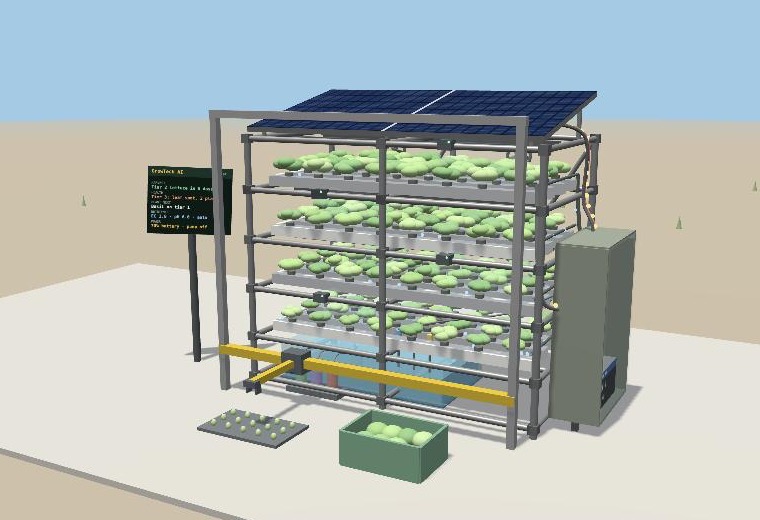
v5 · Robotics Future concept
A robot arm on rails does the hands-on work: planting seedlings, moving them as they grow, and harvesting into a crate. From seedling to harvest with little human effort.
08 Your turn
Explore the farm
Turn and zoom the model, click any part, change the weather or the battery, and speed up time.
VersionWeather (peak sun hours)BatterySpeed
Parts
*Simulated with planning figures: 4 peak sun hours in Accra and about 1,150 Wh used per module per day. Our solar tests will replace them with measured data.
Product roadmap
Five steps to a farm that runs itself
Each version takes over more of the work from the grower, and each one can be sold in its own right. v1 and v2 are built, and v3 is what this raise builds. v4 and v5 are where we are heading; this raise does not fund them.
2023 · builtv1
Single layer
Hydroponics on one level; it could not stack. A lot went wrong with the first lettuce crop, and we fixed what we could.
~70% of the lettuce harvested
2024 · builtv2
Stacked, no solar
Our own stackable layers: each works on its own, and a pump sends nutrient water down through every layer. We grew bell peppers and habaneros.
Suits sites with good grid power
This raise2025 – 2027v3
Solar, sensors, live dashboard
A scaffold module with the solar panel as its roof and a 24 V battery cabinet. Sensors watch the water, temperature and nutrients, and a live dashboard opens on any phone, with SMS alerts.
Building now · Stage 1, GH₵ 60,000
Futurev4
AI
Crop recommendations, camera checks of plant health, and automatic control of water, light and nutrients.
Plan only · not funded by this raise
Futurev5
Robotics
Seeding, transplanting and harvesting.
Plan only · not funded by this raise
v2 Stacked, no solarBuiltv3 Solar + sensorsThis raisev4 AIConceptv5 RoboticsConcept
Images are from our 3D model. v4 and v5 are future concepts that this raise does not fund.
The raise · family & friends round
We are raising in two steps
First we prove one complete v3 module works on solar alone. Only then do we raise for the three pilot modules. Each step has its own budget and its own milestone.
Stage 1● Raising now
Build the v3 working prototype
One complete standalone module, built, wired and grown on, then tested on solar alone for a full week and through a growing cycle.
AmountGH₵ 60,000Build Dec 2026 – Jan 2027 · off-grid test and grow trial Feb 2027
v3 parts, sensors, dashboard, rework28,350
Team part-time pay, 3 months10,500
Hired technicians and design6,900
Tools, transport, testing, grow trial3,450
Legal, accounting, v3 report2,500
Contingency8,300
Stage 2After v3 works
Three MVPs and a partner pilot
Three modules built from the proven design, one each with Holland Greentech, Green Space and Starters Technology, run for six months with our team supervising.
What investors getA SAFE (simple agreement for future equity). It is not a loan: your money turns into GrowTech shares at our next priced share round. The SAFE is signed before any money changes hands.
How we reportBuild photos, test logs and energy readings shared with every investor as each milestone is reached.
The riskThis is an early-stage venture and it could fail. Please only invest an amount you could afford to lose.
Who it's for
From one backyard module to a commercial farm
Tell us your space and what you want to grow. We size the farm, build it, install it and look after it.
1 module
Backyard grower
Fresh greens and herbs at home, as a hobby or for the family table.
3+ modules
Growing business
A row of modules for a restaurant, school, hotel or shop that wants a steady supply.
Rows and levels
Commercial farm
As large and as high as your site allows, all running on solar.
We build, install and maintain every farm.Clients can install and maintain it themselves, but we advise against it.
What we do
From first visit to every harvest
One team handles the whole farm, so a client never has to understand batteries or nutrient levels to grow food.
Plan
We visit the site and size the farm: how many modules, how high, and what to grow.
Build
Scaffold frames, grow channels, solar panels and power cabinets, made in our workshop.
Install
We set it up, connect power and water, and plant the first crop with the client.
Maintain
Regular visits to check the battery, pump and nutrients, and quick fixes so it keeps producing.
Train and supply
Climate-smart farming training and nutrients matched to each crop.
Clients can install and maintain the farm themselves, but we advise against it: our team knows the solar and water systems inside out.
Stage 2 · The pilot
Three pilot farms, three partners
Once v3 is proven, each partner hosts one solar module and grows on it while our team supervises. Their harvests and our energy readings decide what we build and sell next.
1 module each6 monthsJun–Nov 2027
Pilot partner
Module01
Green SpacePilot partner
Module02
Starters TechnologyFounding partner of GrowTech
Module03
Pilot agreements are being prepared and are not yet signed.
Where it started
It began at a vacation camp, teaching 15 children to build a hydroponic farm.
As they worked, we saw what this could become: fresh food grown close to home, in very little space. Three versions later, we are making it run entirely on the sun, so it keeps growing whatever the grid does.
TriumphOwner, director and technician
IsaacTechnical lead
HickmanProject manager and technician
BenTechnician
GideonMentor and supervisor, consulted at every step
Six modules, three wide and two high · from our 3D model
Let's grow together
Talk to us about investing, or about your farm
Call to ask about the raise, arrange a visit to see v2 in operation, or get a quote for a farm.